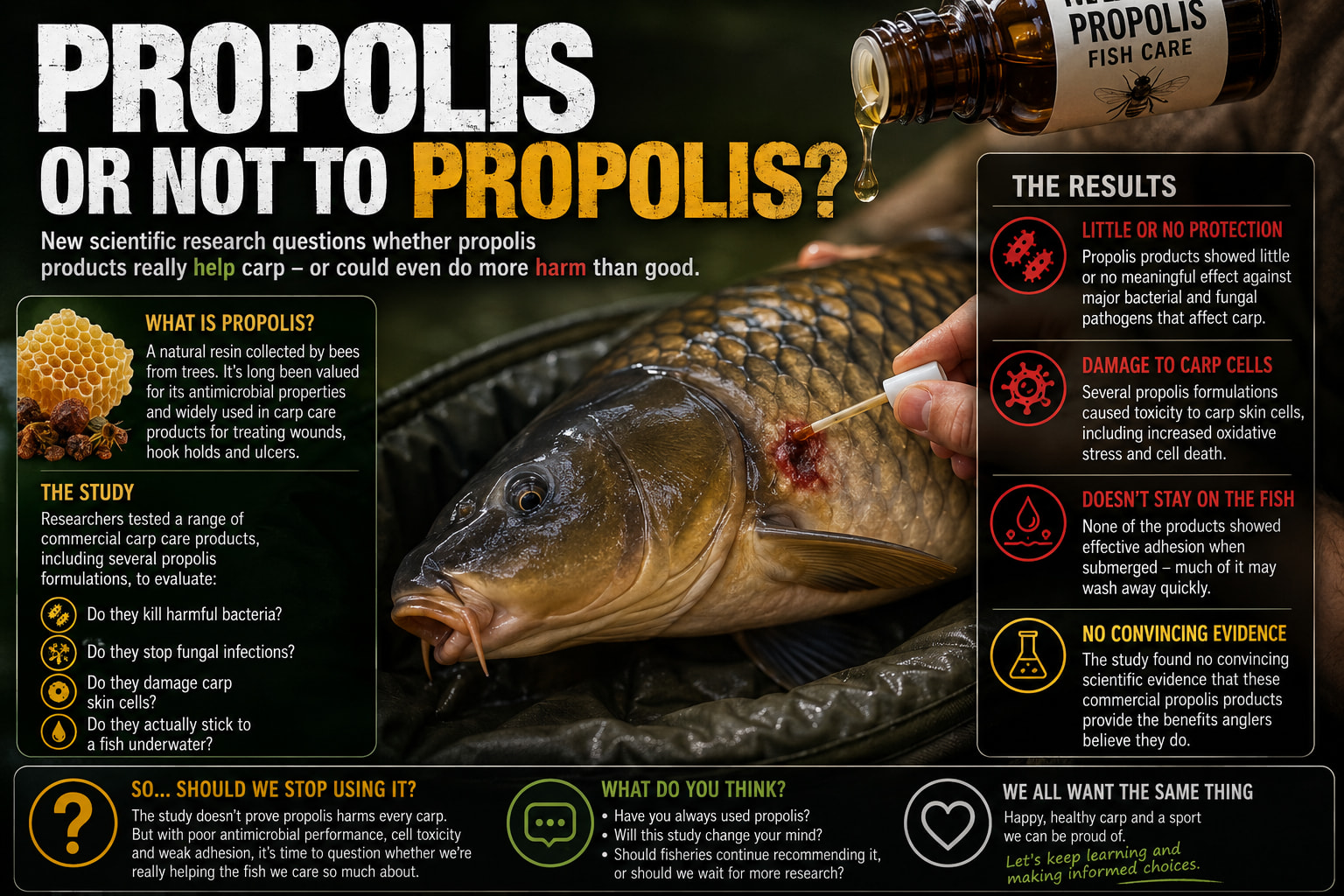
For years we’ve been told that applying propolis to a carp’s hook hold or wound is the responsible thing to do.
Almost every tackle company has sold a bottle at some point. Catch the fish, dab a little propolis on the wound, return it safely and feel like you’ve done your bit.
But a newly published scientific study has questioned whether propolis products are actually helping carp at all.
In fact, the researchers suggest they could even be doing more harm than good.
The Study
Researchers tested a range of commercially available carp care products, including several propolis formulations that are widely used by anglers.
Rather than relying on marketing claims, they looked at four key questions:
-
Do they kill harmful bacteria?
-
Do they stop fungal infections?
-
Do they damage carp skin cells?
-
Do they actually stick to a fish underwater?
The results were surprising.
Little or No Protection Against Fish Pathogens
One of the biggest selling points of propolis has always been its supposed antibacterial properties.
However, when tested against the major bacterial and fungal pathogens that commonly affect carp, the commercial propolis products showed little to no meaningful antimicrobial effect.
In other words…
They weren’t providing the level of protection many anglers have assumed they were.
Damage to Carp Cells
This was perhaps the most concerning finding.
The researchers found that several propolis formulations caused significant toxicity to carp skin cells in laboratory testing.
They observed increased production of reactive oxygen species (ROS), which are associated with oxidative stress, along with evidence of apoptosis—programmed cell death.
Obviously, laboratory studies don’t perfectly recreate what happens on a fish in the lake, but it’s certainly not the result anyone wants to see from a product designed to aid healing.
It Doesn’t Stay on the Fish
Another issue was adhesion.
Because carp are immediately returned to the water, any treatment needs to remain attached long enough to provide a benefit.
The study found that none of the products demonstrated effective submerged wet adhesion.
Essentially, much of the treatment may simply wash away shortly after the fish is returned.
So… Should We Stop Using It?
The study doesn’t conclude that propolis definitely harms every carp.
What it does conclude is that there is currently no convincing scientific evidence that these commercial propolis carp-care products provide the benefits anglers believe they do.
Given the lack of antimicrobial effectiveness, the poor adhesion and the evidence of cellular toxicity, the authors argue that the widespread use of these products should now be questioned until better evidence becomes available.
Why This Matters
Most anglers use propolis because they genuinely care about fish welfare.
Nobody is trying to harm the fish.
If future research confirms these findings, it may be time for manufacturers to rethink how fish care products are formulated, rather than simply relying on a long-standing belief that “propolis is good for wounds.”
Science moves on, and sometimes accepted wisdom turns out not to be quite as accurate as we thought.
What Do You Think?
-
Have you always used propolis after catching a carp?
-
Will this study change your mind?
-
Should fisheries continue recommending propolis, or should we wait for more research?
It’ll be interesting to see how tackle manufacturers respond over the coming months.