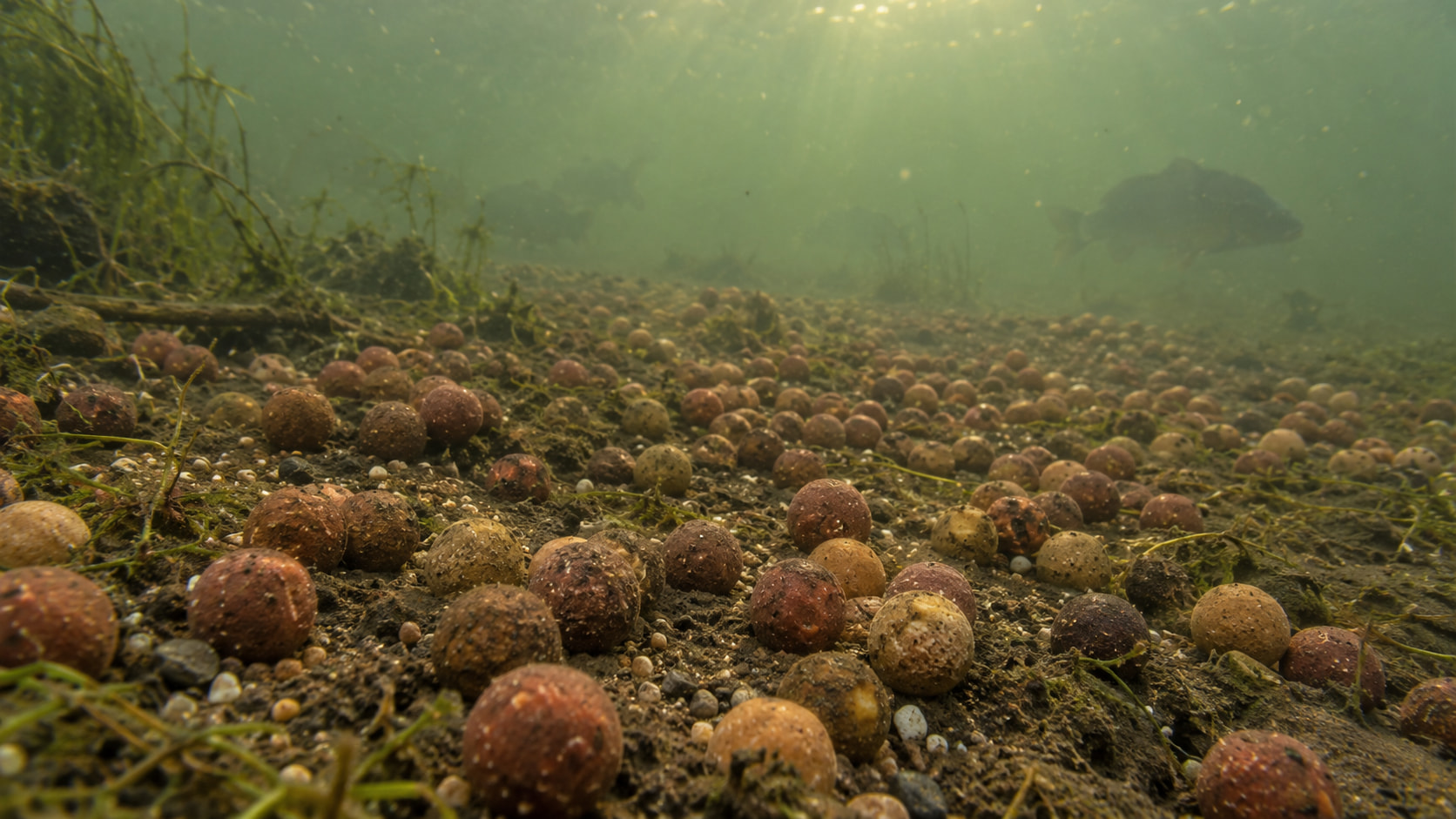
Walk around a busy carp lake on a Friday afternoon and it can feel like half the bait industry is being emptied into the water.
Spombs are flying everywhere.
Buckets are being mixed.
Kilos of boilies, particles and pellets are going in before many anglers have even seen a fish.
Heavy baiting absolutely has its place, but there is a growing argument that some waters are simply receiving too much.
The immediate issue is fishing.
If ten anglers each introduce several kilos of bait over a weekend, the carp suddenly have an enormous amount of food available.
On a heavily stocked water, they may clear it.
On a lower-stock venue, a lot of that bait may simply sit there.
That can make fishing harder rather than easier.
There is also a wider question about what all that uneaten bait does to a lake.
Organic matter eventually breaks down. In extreme situations, excessive baiting can potentially contribute to poor water quality, particularly in small, heavily pressured waters.
The answer is not to stop baiting.
The answer is to think about what the lake can actually support.
Stock density matters.
Time of year matters.
Water temperature matters.
The number of anglers matters.
If the lake is full of hungry carp in warm conditions, heavy baiting can produce incredible results.
If it is February, there are twenty carp in ten acres and six anglers have already filled it in, another five kilos may not be particularly clever.
Carp anglers often talk about reading the water.
Perhaps we should also get better at reading how much food is already in it.